Debt snowball vs avalanche: which pays off debt faster? (worked example)
The debt snowball pays off your smallest balance first; the debt avalanche pays off your highest interest rate first. Either way you pay the minimum on everything else and roll each freed-up payment into the next debt. Avalanche always costs the same or less interest, while snowball gets you a paid-off account sooner: in our worked example ($24,100 across four debts, $400 a month extra), avalanche saved $436.61 and one month, but snowball cleared the first debt in month 3 instead of month 14.
Updated November 16, 2026 · About 6 minutes to read
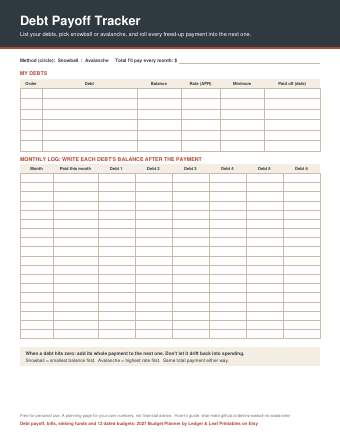
Free printable: Debt payoff tracker
One page, US Letter, print and fill in by hand. No email sign-up.
Download the free PDFHow each method works
Both methods use the same monthly amount. You decide how much you can put toward debt in total, pay every minimum, and send whatever is left to one target debt. When the target is paid off, its whole payment rolls onto the next target. The only difference is the order.
| Debt snowball | Debt avalanche | |
|---|---|---|
| Target first | Smallest balance | Highest interest rate |
| Good at | Quick wins, fewer bills to juggle sooner | Lowest total interest, usually a slightly earlier finish |
| Weak spot | A big high-rate card can sit there growing | The first payoff can take a year or more |
The worked example: four debts, $24,100
This is a realistic Canadian mix: a store card, a Visa, a line of credit and a car loan. The minimums add up to $650 a month. The numbers work the same in US dollars.
| Debt | Balance | Interest rate (APR) | Minimum payment | Snowball order | Avalanche order |
|---|---|---|---|---|---|
| Store card | $900 | 19.99% | $30 | 1 | 2 |
| Visa | $7,400 | 22.99% | $220 | 3 | 1 |
| Line of credit | $3,200 | 9.95% | $65 | 2 | 3 |
| Car loan | $12,600 | 7.99% | $335 | 4 | 4 |
| Total | $24,100 | $650 |
How we ran it: interest is added monthly at APR/12, every minimum is paid every month, and the minimums are held at their starting amount (which is what you do on a payoff plan, even when the card's required minimum drops). Real cards usually calculate interest daily, so your statement will differ by a few dollars, not by hundreds.
The results
| Extra per month | Method | Debt-free in | Total interest | First debt paid off |
|---|---|---|---|---|
| $0 | Snowball | 49 months | $7,642.19 | Store card, month 42 |
| $0 | Avalanche | 49 months | $7,604.07 | Store card, month 42 |
| $200 | Snowball | 35 months | $4,914.40 | Store card, month 5 |
| $200 | Avalanche | 34 months | $4,337.17 | Visa, month 22 |
| $400 | Snowball | 27 months | $3,609.99 | Store card, month 3 |
| $400 | Avalanche | 26 months | $3,173.38 | Visa, month 14 |
With $400 a month extra:
- Snowball pays them off in this order: Store card (month 3), Line of credit (month 9), Visa (month 20), Car loan (month 27). Total interest $3,609.99.
- Avalanche pays them off in this order: Visa (month 14), Store card (month 15), Line of credit (month 19), Car loan (month 26). Total interest $3,173.38.
So avalanche wins by $436.61 and one month. Snowball gives you your first paid-off account in month 3. On avalanche you're 14 months in before anything is closed, which is a long time to see four balances on every statement.
The bigger lesson: the extra amount matters more than the method
Look at the first two rows. With no extra money (you still roll each freed-up minimum into the next debt), it takes 49 months and about $7,604 in interest either way; the methods are only $38 apart. Adding $200 a month cuts that to 34 to 35 months. Adding $400 cuts it to 26 to 27 months and roughly halves the interest. Picking the "right" method is worth a few hundred dollars here. Finding the extra $400 is worth over $4,000.
If you don't know where an extra $200 or $400 would come from, start with a monthly budget. The money usually turns up in two places: subscriptions and food you didn't plan.
Which one should you pick?
Pick avalanche if the gap between your interest rates is big (say, a 22.99% card next to a 7.99% car loan) and you're the kind of person who can keep going without a quick win. The bigger your highest-rate balance, the more avalanche saves.
Pick snowball if you've started and stopped before, if you have several small balances that clutter your month, or if your rates are all close together. When rates are similar, the interest difference is small and the motivation difference is large.
Check this first: if your smallest balance also has the highest rate, both methods give you the exact same plan. Just start.
A hybrid that works for a lot of people: pay off any debt under about $1,000 first, for the win and one less bill, then switch to avalanche for the rest. In our example, that means the store card first (it's gone in month 3), then the Visa.
How to set up your payoff plan in 20 minutes
- List every debt with its balance, interest rate and minimum payment. Pull these from your latest statements, not memory. Leave out your mortgage; payoff plans are for consumer debt.
- Decide your total monthly debt amount: all minimums plus the extra you can commit to every month. Write it down. This number stays the same until you're done.
- Number the debts in your chosen order: smallest balance first (snowball) or highest rate first (avalanche).
- Pay minimums on everything, and the rest on debt #1. Set up the minimums on autopay so a missed payment can't undo your progress.
- Log each payment and the new balance once a month, the day the statement comes in.
- When a debt hits zero, add its whole payment to the next one. Don't let the freed-up money drift back into everyday spending. That roll-over is the entire method.
What breaks a debt payoff plan
- Still using the cards. If the balance you're paying down is also growing, nothing works. Take the card out of your wallet and your phone's saved payments.
- No buffer. The first surprise car repair goes straight back on the Visa. Many people keep a small starter buffer, $500 to $1,000, before putting everything into debt.
- Forgetting yearly bills. These are what usually send people back to the card. Sinking funds handle them.
- A balance transfer with no plan. A low promotional rate helps only if you pay the balance down before the promo ends. Check the transfer fee and the rate afterward.
If the numbers don't work at all
If your minimums alone are more than you can pay, a payoff method won't fix it. Call your lenders before you miss a payment; many have hardship options. Free, non-profit credit counselling can also help you look at the whole picture: in Canada, the Credit Counselling Society; in the US, agencies that belong to the National Foundation for Credit Counseling (NFCC). This guide is general information, not financial advice for your situation.
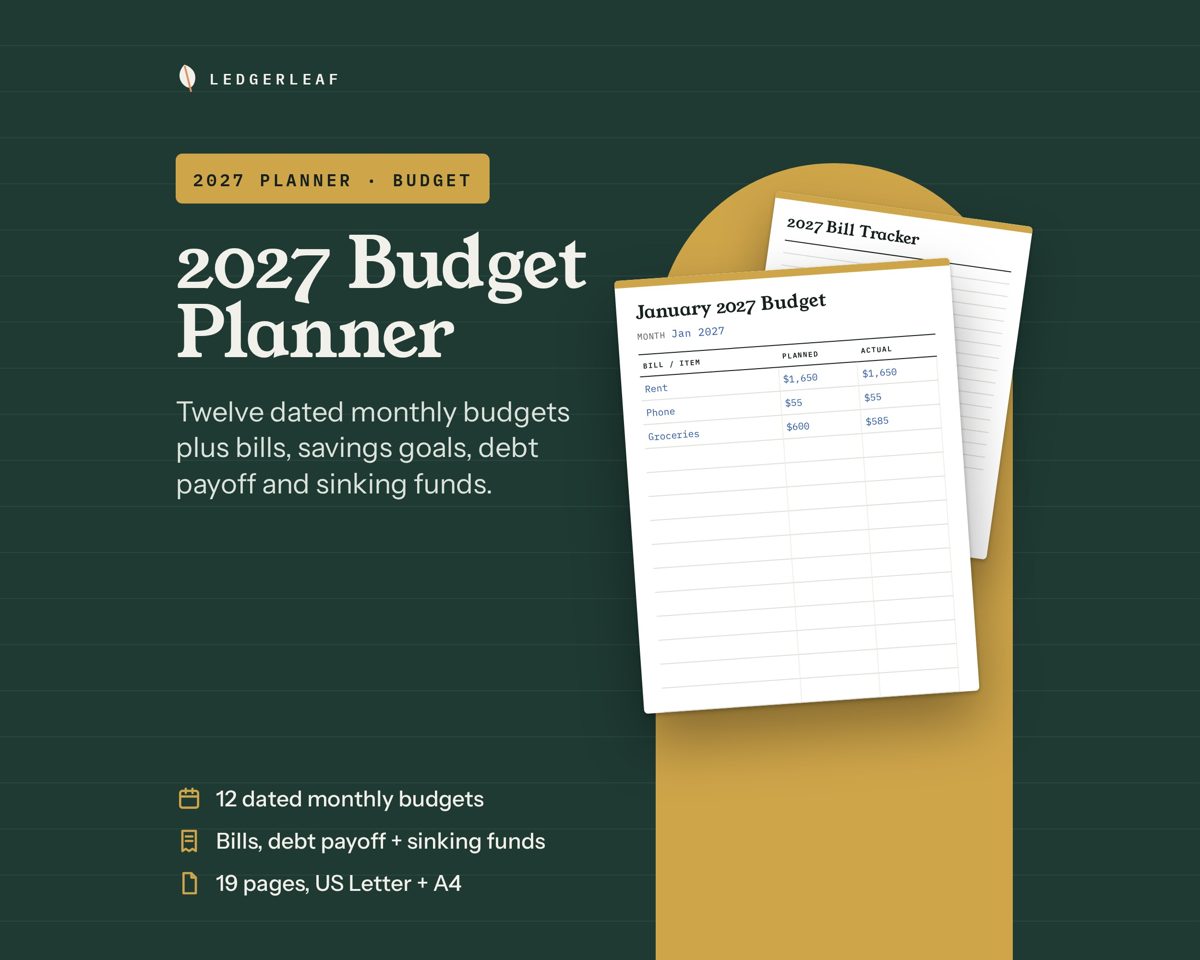
2027 Budget Planner Printable
The 2027 Budget Planner has a debt payoff tracker (debt list and payment log) alongside 12 dated monthly budgets, a bill tracker, sinking funds and savings goals, so your debt plan sits inside the rest of your budget. 19 pages, US Letter and A4, fillable or print-at-home.
Shop sale: everything in the Etsy shop is 50% off until December 15, 2026.
See the 2027 Budget Planner Printable on EtsyThe spreadsheet version has a debt payoff tab for 8 debts that totals your payments and the balance left (check your statements for interest). 2027 Household Budget Spreadsheet on Etsy.
Questions people ask
Is the debt snowball or avalanche better?
Avalanche (highest interest rate first) always costs the same or less interest. Snowball (smallest balance first) gives you a paid-off account sooner, which helps many people keep going. In our example with $24,100 of debt and $400 a month extra, avalanche saved $436.61 and one month.
Do I include my mortgage in the debt snowball?
Usually not. Snowball and avalanche plans are for consumer debt: credit cards, lines of credit, car loans, personal loans and student loans. Your mortgage stays on its regular payment.
What if two debts have the same interest rate?
Pay the smaller balance first. You get the payoff sooner and the interest cost is the same.
Should I stop saving while I pay off debt?
Most people keep a small buffer, often $500 to $1,000, so a surprise expense doesn't go back on a credit card. Beyond that it depends on your rates and situation.
How much faster does an extra payment pay off debt?
In our worked example, minimums alone took 49 months. Adding $200 a month cut it to 34 to 35 months, and $400 a month cut it to 26 to 27 months, roughly halving the interest.
Does the free debt payoff tracker do the math?
No. It's a one-page printable where you list your debts in payoff order and log each month's payment and balance by hand. The spreadsheet version on Etsy totals payments for you.
We add a new free printable guide to this site most weeks and new planners to the shop. Follow LedgerLeaf Printables on Etsy to see new printables first, or follow LedgerLeaf on Pinterest for the new free pages. Following also gets you sale alerts: Etsy sends shop followers updates on the shop's sales, coupons and new items (follow for sale alerts).
More money guides
- How to make a monthly budget (with a real example in CAD and USD)
- Sinking funds: what they are, 24 categories and how much to put in each
- How to keep track of bills: a bill tracker that matches your paydays
- 2027 budget planner: what to include, your 2027 paydays, and a free printable
- No spend January 2027: rules, calendar and a free rules sheet
- Christmas gift budget tracker: how to plan holiday spending