How to make a monthly budget (with a real example in CAD and USD)
To make a monthly budget, write down your take-home pay for the month, list your fixed bills, then give every remaining dollar a job (groceries and day-to-day spending, debt payments, savings) until income minus everything equals zero. Use the smallest normal month of pay you can count on, not your best month. Then track what you actually spend for 30 days and adjust, because the first version is always wrong somewhere.
Updated November 16, 2026 · About 7 minutes to read
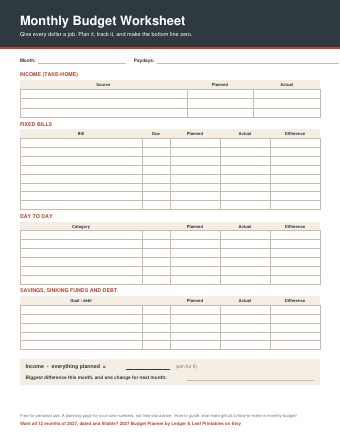
Free printable: Monthly budget worksheet
One page, US Letter, print and fill in by hand. No email sign-up.
Download the free PDFBefore you start: 15 minutes of gathering
You can't budget from memory. Before you write a single number, pull up three things:
- Your last two or three months of bank and credit card statements (download them as PDFs or CSVs).
- Your most recent pay stubs, so you know your real take-home amount, after tax, benefits and pension or 401(k).
- Anything you pay once or twice a year: car insurance, a Costco or Amazon membership, property tax, a domain name, school fees.
That last list is where most first budgets break. A $900 insurance renewal in August is a $75-a-month cost, whether or not you plan for it.
Step 1: Pick your income number
Use take-home pay, the amount that actually lands in your account. Then use the smallest normal month, not an average:
- Paid every two weeks: budget on two paycheques a month. Two months a year you'll get a third one. With a Friday payday starting January 8, 2027, those months are April, October. Decide now where the third cheque goes (debt, a sinking fund, or the emergency fund) so it doesn't quietly disappear.
- Paid weekly: budget on four paycheques, even in five-Friday months.
- Paid on the 15th and last day: two cheques, every month. This is the easiest schedule to budget.
- Irregular income (freelance, tips, commission): take the three lowest months from the last 12 and average them. Anything above that number goes into a holding account and gets assigned the next month.
Step 2: List your fixed bills
Fixed bills are the ones that come with a late fee or a cancellation if you skip them: rent or mortgage, utilities, internet, phone, insurance, transit or car payment, minimum debt payments, childcare, and subscriptions. Write the amount and the due day for each. If something is billed yearly, divide it by 12 and put it under sinking funds in Step 5 instead.
Step 3: Put real numbers on day-to-day spending
This is groceries, gas, eating out, household stuff, personal care and fun money. Don't guess. Add up each category from your last two or three statements and divide by the number of months. If your statements say you spent $612, $540 and $588 on groceries, your grocery line is $580, not the $400 you wish it were. You can aim lower next month once you know the real starting point.
Keep a fun-money line, even a small one. A budget with zero room for a takeout night tends to last about three weeks.
Step 4: Add debt payments
Every debt gets at least its minimum payment. If you have money left after Step 5, extra debt payments go here too. Which debt gets the extra is a separate decision; we walk through it with real numbers in debt snowball vs avalanche.
Step 5: Add savings and sinking funds
Savings is two different jobs. An emergency fund covers things you can't predict (job loss, a burst pipe). Sinking funds cover things you can: Christmas, car repairs, the dentist, the annual renewal you forgot about last year. A simple rule: total up last year's irregular costs, divide by 12, and that's your monthly sinking-fund line. There's a full list of categories with amounts in our sinking funds guide.
Step 6: Make it zero
Add a running "left to assign" column. Start with your income at the top and subtract each line as you go. When you reach the bottom, the number should be exactly $0. If it's negative, cut from the bottom of the list (the least important lines) until it isn't. If it's positive, that money still needs a job: give it to a goal. This is what people mean by a zero-based budget. It doesn't mean you spend everything. It means every dollar, including the ones you save, is assigned on purpose.
Worked example 1: a single renter in Vancouver (CAD)
Take-home pay is $2,150 every second Friday. The budget is built on two cheques, so $4,300.
| Line | Group | Amount | Left to assign |
|---|---|---|---|
| Take-home pay (2 biweekly cheques x $2,150) | Income | $4,300 | $4,300 |
| Rent, one-bedroom | Fixed | $2,050 | $2,250 |
| Hydro (electricity) | Fixed | $45 | $2,205 |
| Internet | Fixed | $70 | $2,135 |
| Phone | Fixed | $55 | $2,080 |
| Tenant insurance | Fixed | $25 | $2,055 |
| Transit pass | Fixed | $110 | $1,945 |
| Visa minimum payment | Fixed | $120 | $1,825 |
| Subscriptions (2) | Fixed | $28 | $1,797 |
| Groceries | Day to day | $450 | $1,347 |
| Eating out and coffee | Day to day | $160 | $1,187 |
| Personal and household | Day to day | $90 | $1,097 |
| Fun money | Day to day | $100 | $997 |
| Sinking funds (gifts, dental, travel, clothes) | Savings and debt | $300 | $697 |
| Emergency fund | Savings and debt | $250 | $447 |
| Extra on the Visa | Savings and debt | $200 | $247 |
| TFSA | Savings and debt | $247 | $0 |
The bottom line is $0, so every dollar has a job. Rent alone is 48% of take-home pay, which is normal for a Vancouver one-bedroom and the reason the next section matters.
Worked example 2: a couple in Columbus, Ohio (USD)
Two earners, combined take-home of $5,800 a month, paid on the 15th and the last day of the month.
| Line | Group | Amount | Left to assign |
|---|---|---|---|
| Take-home pay (two earners, paid on the 15th and last day) | Income | $5,800 | $5,800 |
| Mortgage (incl. property tax and insurance) | Fixed | $1,640 | $4,160 |
| Electric, gas and water | Fixed | $260 | $3,900 |
| Internet and two phones | Fixed | $150 | $3,750 |
| Car insurance | Fixed | $180 | $3,570 |
| Car payment | Fixed | $410 | $3,160 |
| Student loan minimum | Fixed | $310 | $2,850 |
| Subscriptions (3) | Fixed | $45 | $2,805 |
| Groceries | Day to day | $900 | $1,905 |
| Gas for two cars | Day to day | $220 | $1,685 |
| Eating out | Day to day | $250 | $1,435 |
| Personal and household | Day to day | $150 | $1,285 |
| Fun money (split two ways) | Day to day | $150 | $1,135 |
| Sinking funds | Savings and debt | $450 | $685 |
| Emergency fund | Savings and debt | $300 | $385 |
| Roth IRA | Savings and debt | $385 | $0 |
Same method, different shape: housing is a smaller share, but two car payments and a student loan take up the space instead.
What about the 50/30/20 rule?
The 50/30/20 rule says 50% of take-home pay goes to needs, 30% to wants and 20% to savings and extra debt payments. It's a fine sanity check, but don't force your budget to fit it. In the Vancouver example, needs (fixed bills plus groceries) come to $2,953 out of $4,300, or 68.7%. No amount of skipped lattes turns that into 50%. In the Ohio example, needs (fixed bills, groceries and gas) are $4,115 of $5,800, or 70.9%. If your needs are over 60%, the useful question isn't "how do I hit 50/30/20" but "which one big cost (rent, car, phone plan) can I change in the next year?"
Step 7: Track it for 30 days
Your plan is a guess until you compare it with what actually happened. Give each line two more columns, Actual and Difference. Once a week, on the same day (Sunday evening works for most people), open your banking app and add up what you spent in each category. It takes about 10 minutes if you do it weekly and an hour if you leave it to the end of the month.
Step 8: The month-end review
On the last day of the month, answer four questions, in writing:
- Which line was furthest off, and was the plan wrong or the spending?
- What came up that wasn't on the list at all? (Add it, or add it to a sinking fund.)
- Did the third paycheque, refund or bonus get assigned, or did it vanish?
- What's one number you'll change for next month?
Expect the first three months to be messy. By month three, your fixed lines should match to the dollar, and the day-to-day lines will be close enough to plan with.
Why first budgets fail
- Forgetting yearly costs. The car insurance renewal shows up, the budget "breaks," and people quit. Sinking funds fix this.
- Budgeting groceries from memory. Use your statements.
- No fun money. Even $50 a month makes the rest easier to stick to.
- Starting mid-month with no buffer. If you can, start on the 1st, or right after a payday.
- Two people, two budgets. If you share bills, sit down together for the first version. One person building the budget and the other finding out about it later almost never works.
Paper, spreadsheet or app?
Use the one you'll actually open every week. Paper is slower to update but you see the whole month at a glance, and writing numbers by hand makes people notice them. A spreadsheet does the math for you and is easier to copy month to month. Apps that link to your bank save typing, but they categorize things automatically, and it's easy to stop looking. Plenty of people use a spreadsheet for tracking and a printed one-page plan on the fridge.
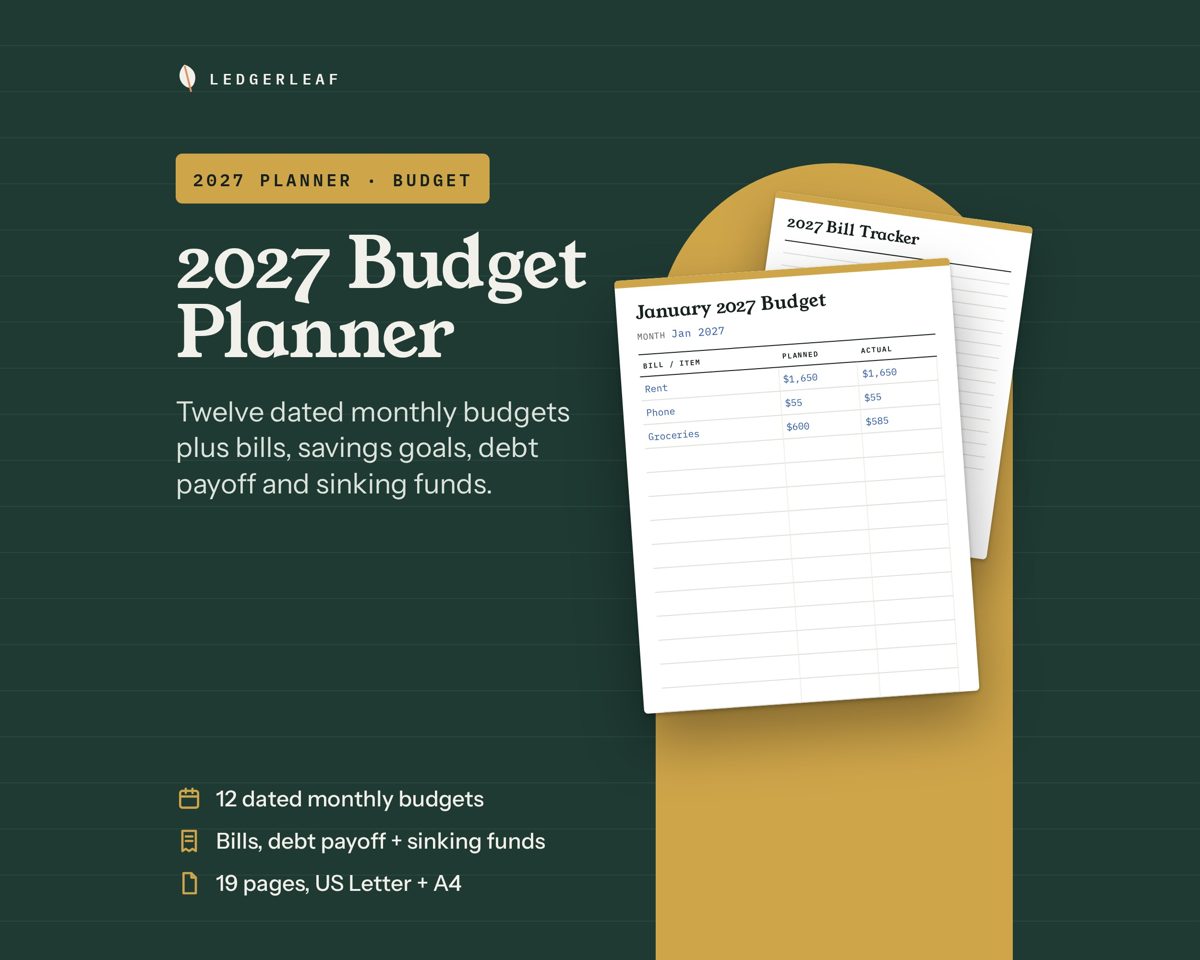
2027 Budget Planner Printable
Want all 12 months done for you? The 2027 Budget Planner has a dated monthly budget page for every month of 2027 (income, fixed bills, everyday spending, savings and debt, and a month summary), plus a bill tracker, debt payoff tracker, sinking funds page, savings goals and an expense log. 19 pages, US Letter and A4, fillable or print-at-home.
Shop sale: everything in the Etsy shop is 50% off until December 15, 2026.
See the 2027 Budget Planner Printable on EtsyPrefer a spreadsheet? The Excel and Google Sheets version does the totals for you. It's a spreadsheet, not a printable PDF. 2027 Household Budget Spreadsheet on Etsy.
Questions people ask
How much should I budget for groceries?
Use your own number, not a national average. Add up grocery spending on your last two or three bank and card statements and divide by the number of months. Start the budget there, then lower it by $25 to $50 a month if you want to bring it down.
What is a zero-based budget?
A zero-based budget gives every dollar of your monthly income a job, including savings, so income minus all the lines equals exactly zero. It doesn't mean spending everything; money you save is assigned to a savings line.
How do I make a budget with irregular income?
Base the budget on the average of your three lowest months from the last year. Put anything you earn above that into a holding account and assign it in the following month, starting with bills and the emergency fund.
Should I budget weekly or monthly?
Plan monthly, because most bills are monthly, but check in weekly. A 10-minute weekly check on the same day each week catches overspending while you can still fix it.
Does the 50/30/20 rule work if I live somewhere expensive?
Often not. In an expensive city, rent alone can be close to half of take-home pay, so needs end up at 60 to 70%. Use 50/30/20 as a reference point and build your actual budget line by line.
Is the free budget worksheet fillable?
The free worksheet is a one-page PDF to print and fill in by hand. The paid 2027 Budget Planner on Etsy is fillable, so you can type into it in Adobe Acrobat Reader or most PDF apps.
We add a new free printable guide to this site most weeks and new planners to the shop. Follow LedgerLeaf Printables on Etsy to see new printables first, or follow LedgerLeaf on Pinterest for the new free pages. Following also gets you sale alerts: Etsy sends shop followers updates on the shop's sales, coupons and new items (follow for sale alerts).
More money guides
- Debt snowball vs avalanche: which pays off debt faster? (worked example)
- Sinking funds: what they are, 24 categories and how much to put in each
- How to keep track of bills: a bill tracker that matches your paydays
- 2027 budget planner: what to include, your 2027 paydays, and a free printable
- No spend January 2027: rules, calendar and a free rules sheet
- Christmas gift budget tracker: how to plan holiday spending