Sinking funds: what they are, 24 categories and how much to put in each
A sinking fund is money you set aside every month for a cost you know is coming but don't pay monthly, like car insurance, Christmas or the vet. To set one up, take the expected cost, divide it by the number of months until it's due, and move that amount into savings each payday. Most households need 6 to 12 funds; the most common are car repairs, gifts and holidays, yearly bills, home repairs, medical and dental, pets, travel and clothing.
Updated November 16, 2026 · About 5 minutes to read
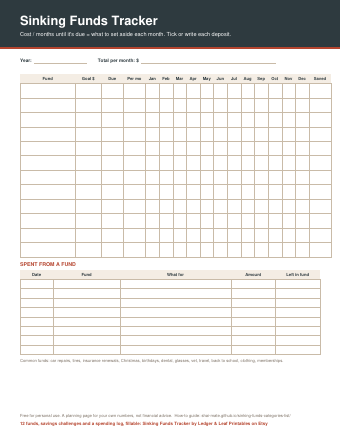
Free printable: Sinking funds tracker
One page, US Letter, print and fill in by hand. No email sign-up.
Download the free PDFSinking fund vs emergency fund
| Sinking fund | Emergency fund | |
|---|---|---|
| For | Costs you can see coming | Things you can't predict |
| Examples | Christmas, insurance renewal, new tires, the dentist | Job loss, a burst pipe, a sudden trip home |
| How much | The expected cost of each item | Often 3 to 6 months of essential expenses |
| You spend it | On schedule, and that's the plan | Only when something goes wrong |
The difference matters because most "emergencies" aren't. New tires every few years, a vet bill, a December that costs $900 more than November: those are predictable. Without sinking funds they land on a credit card or empty the emergency fund, and then a real emergency has nowhere to go.
The formula
Cost / months until you need it = monthly amount. That's it. A few examples, starting in January 2027:
| Goal | Cost | Needed by | Months to save | Per month |
|---|---|---|---|---|
| Christmas 2027 | $900 | December 1, 2027 | 11 | $81.82 |
| Car insurance renewal | $1,860 | August 2027 | 8 | $232.50 |
| Summer trip | $1,800 | July 2027 | 6 | $300 |
| New laptop | $1,200 | in 18 months | 18 | $66.67 |
If you start later, the monthly number goes up. Christmas 2027 started in January is $81.82 a month; started in June it's $150. That's why January is the best time to set these up, and why the first year always feels expensive: you're catching up on funds that, ideally, would have started months ago.
24 sinking fund categories, with amounts
The amounts below are an example household, not a target. Use your own numbers: the best source is last year's bank and card statements. Skip any line that doesn't apply to you.
| Group | Sinking fund | Example cost per year | Per month |
|---|---|---|---|
| Car | Car maintenance (oil, wipers, inspections) | $600 | $50 |
| Car | Tires and brakes | $480 | $40 |
| Car | Car insurance, if paid yearly | $1,800 | $150 |
| Car | Registration, licence and parking permits | $240 | $20 |
| Home | Home repairs and appliances | $1,200 | $100 |
| Home | Furniture and household replacements | $360 | $30 |
| Home | Property tax, if not in your mortgage | $3,600 | $300 |
| Health | Dental, beyond what insurance covers | $420 | $35 |
| Health | Glasses and contacts | $300 | $25 |
| Health | Prescriptions and physio | $240 | $20 |
| Pets | Vet visits and vaccines | $600 | $50 |
| Pets | Pet insurance or boarding | $360 | $30 |
| Gifts and holidays | Christmas (gifts, food, cards, travel) | $900 | $75 |
| Gifts and holidays | Birthdays | $360 | $30 |
| Gifts and holidays | Weddings and showers | $300 | $25 |
| Travel | Summer trip | $1,800 | $150 |
| Travel | Visiting family | $600 | $50 |
| Kids | Back to school | $450 | $38 |
| Kids | Sports, camps and lessons | $900 | $75 |
| Yearly bills | Memberships (Costco, Amazon, gym) | $250 | $21 |
| Yearly bills | Software, domains and app subscriptions billed yearly | $120 | $10 |
| Personal | Clothing and shoes | $600 | $50 |
| Personal | Haircuts | $360 | $30 |
| Other | Electronics replacement (phone, laptop) | $600 | $50 |
Nobody needs all 24. If you added every line above it would be about $1,453 a month, which is why you pick the ones that match your life and leave the rest out.
How to find your real numbers in 20 minutes
- Open last year's statements (or the last 12 months) for your main bank account and every credit card.
- Search for words that catch irregular costs: insurance, renewal, annual, membership, dental, vet, tire, garage, airline, hotel, Amazon.
- Write down every charge that wasn't monthly, with the amount and month.
- Group them. You'll usually end up with 6 to 12 groups.
- Divide each group's yearly total by 12. Round up to the nearest $5.
Most people are surprised by one group in particular. For a lot of households it's gifts: once you add birthdays, a wedding, two baby showers and Christmas, the year's total is usually far higher than anyone guessed.
If money is tight: a starter set
You don't have to fund everything at once. If you can only spare $150 a month, split it across the five funds that most often send people back to a credit card:
- Car repairs: $50
- Christmas and birthdays: $45
- Medical and dental: $25
- Yearly bills: $20
- Clothing: $10
Then raise one fund at a time, for example whenever you pay off a debt or get a raise. A partly funded sinking fund still means the next surprise is smaller.
Where to keep the money
You have two good options:
- One savings account and a tracker. All sinking-fund money sits in one high-interest savings account, and a paper or spreadsheet tracker shows how much of the balance belongs to each fund. Simple, and fewer accounts to manage.
- Separate accounts or "buckets." Some online banks let you split one savings account into named sub-accounts. You see each fund's balance in the app, but you still need to update them.
Keep sinking-fund money somewhere boring and easy to reach. It's money you plan to spend within a year or two, so it shouldn't be in investments that can drop 20% the month before you need it.
Running it month to month
- Payday: move the total into savings the same day the cheque lands. Automate it if you can.
- Tracker: add each fund's share to its row, so the row totals always match the account balance.
- Spending from a fund: pay with your normal card, then move the money from savings to cover it and log it on the fund's row. That's the fund doing its job; don't feel guilty about it.
- When a fund runs short: cover the gap from a fund with slack (not the emergency fund if you can avoid it), then raise that fund's monthly amount next year.
- Every January: look at what each fund actually paid for, adjust the amounts, and start a fresh tracker page.
How sinking funds fit in your budget
In a monthly budget, sinking funds are a single line, like "Sinking funds: $300." The breakdown lives on the tracker. In our monthly budget worked example, a Vancouver renter puts $300 a month into gifts, dental, travel and clothing. If you're paying off debt, sinking funds are what stop new charges going back on the card you just paid down (more in debt snowball vs avalanche). Yearly bills, like insurance paid annually, can also go on your bill tracker, so you see the due date coming.
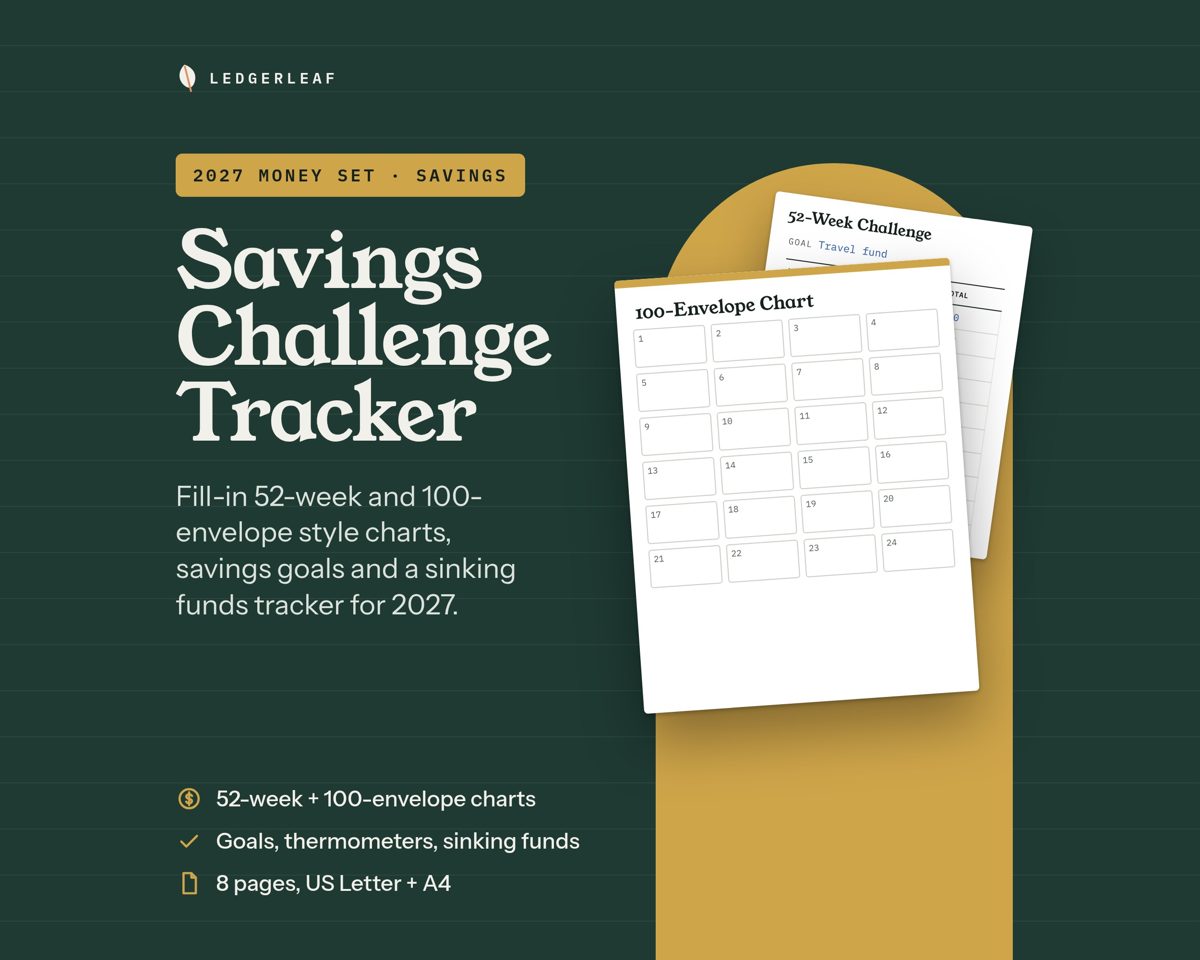
Sinking Funds Tracker Printable
The Sinking Funds Tracker printable has a 12-fund by 12-month tracker with a log of what you spent from each fund, plus a savings goal tracker, a fill-in 52-week savings challenge and a 100-envelope chart. 8 pages, US Letter and A4, fillable.
Shop sale: everything in the Etsy shop is 50% off until December 15, 2026.
See the Sinking Funds Tracker Printable on EtsyWant sinking funds inside a full budget? The 2027 Budget Planner includes a 16-fund sinking funds page next to 12 dated monthly budgets. 2027 Budget Planner Printable on Etsy.
Questions people ask
How many sinking funds should I have?
Most households do well with 6 to 12. Start with the costs that hit you hardest last year, often car repairs, gifts and holidays, medical and dental, and yearly bills, and add more once those are running.
Should sinking funds be in a separate account?
They don't have to be. Many people keep all sinking-fund money in one high-interest savings account and use a tracker to show how much belongs to each fund. Separate accounts or bank 'buckets' also work if you like seeing each balance.
Is a sinking fund the same as an emergency fund?
No. A sinking fund is for a cost you know is coming, like Christmas or a tire replacement. An emergency fund is for things you can't predict, like losing your job.
How do I calculate a sinking fund amount?
Divide the expected cost by the number of months until you need the money. For example, $900 for Christmas starting in January 2027 is $900 / 11 = about $82 a month.
What if I can't afford to fund all of them?
Start with a small total, for example $150 a month split across car repairs, gifts, medical, yearly bills and clothing, and increase one fund at a time as debts are paid off or income goes up.
Is the free sinking funds tracker fillable?
The free tracker is a one-page printable for 10 funds over 12 months that you fill in by hand. The paid Sinking Funds Tracker on Etsy is a fillable PDF with 12 funds, a spending log and savings challenges.
We add a new free printable guide to this site most weeks and new planners to the shop. Follow LedgerLeaf Printables on Etsy to see new printables first, or follow LedgerLeaf on Pinterest for the new free pages. Following also gets you sale alerts: Etsy sends shop followers updates on the shop's sales, coupons and new items (follow for sale alerts).
More money guides
- 52 week savings challenge printable: 2027 dates and a free chart
- Family emergency binder: what to put in it, with a free checklist
- How to make a monthly budget (with a real example in CAD and USD)
- Debt snowball vs avalanche: which pays off debt faster? (worked example)
- How to keep track of bills: a bill tracker that matches your paydays
- 2027 budget planner: what to include, your 2027 paydays, and a free printable
- No spend January 2027: rules, calendar and a free rules sheet
- Christmas gift budget tracker: how to plan holiday spending